
A version of the following article appeared in the June 24, 2026, edition of The Charlotte Ledger, an e-newsletter with local business-y news and insights for Charlotte, N.C.
Need to subscribe — or upgrade your Ledger e-newsletter subscription? Details here.
LEDGER IN-DEPTH
Rob Harrington, Charlotte’s next mayor, brings deep connections and a low-key style; ‘Rob has all the chill’

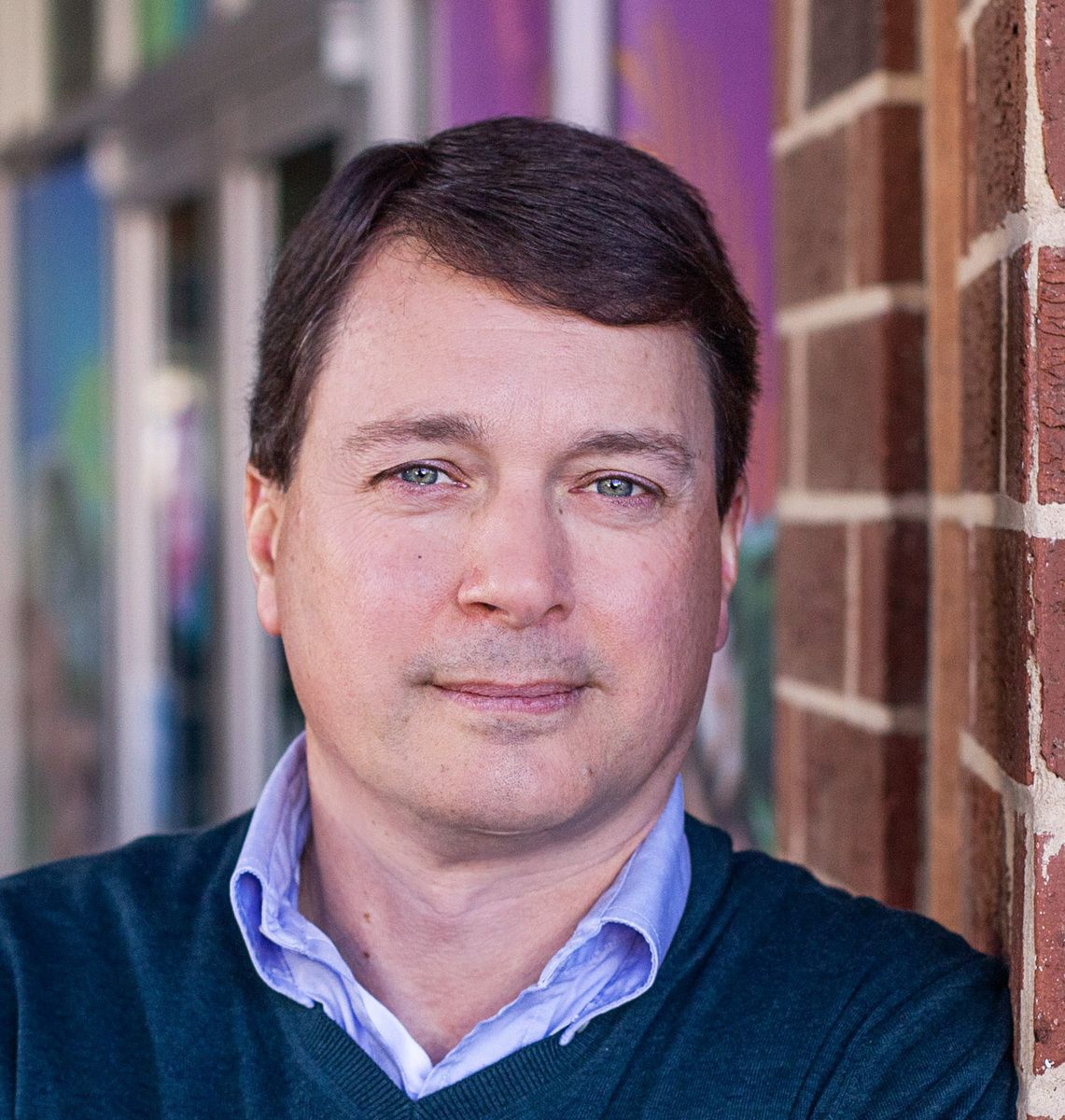
Rob Harrington will be sworn in as Charlotte’s mayor on July 1. He was selected to replace Mayor Vi Lyles, who is resigning June 30, in a 6-5 vote during a second ballot by Charlotte City Council. (Photo by Tony Mecia/The Charlotte Ledger)
by Tony Mecia and Ashley Fahey
Asked why he wanted to be Charlotte’s next mayor, Rob Harrington shared a story from his upbringing in Florence, S.C.
He grew up in a working-class family, he said, and he recalled his father helping a neighbor who couldn’t read. Harrington’s father would go through the man’s bills every week, and the neighbor would repay the kindness on Saturdays by bringing over a box of grapefruits and Cokes to the Harrington home.
“That’s an individual level of help your neighbor — literally — and your neighbor helped back in the way that they can,” said Harrington, in an interview last week on the podcast “R&D in the NC.” “That’s been, for me, … that’s who you are. You can’t outrun it.”
The lesson stuck. Decades later, Harrington will have the chance to serve 965,000 of his neighbors. He’ll lead the country’s 14th-largest city as mayor starting next week, when he replaces Mayor Vi Lyles, who is stepping down to spend more time with family. The council chose him from among five candidates in a 6-5 vote on the second ballot Monday night.
On Tuesday, people who know him best described him as the right leader for the moment: a lawyer skilled at handling conflict, an experienced civic board member with connections and people skills, and a low-key problem-solver who is motivated by helping others.
“Rob has all the chill,” said Amy Hawn Nelson, who chairs the board of the Charlotte Mecklenburg Library and served with Harrington when he chaired it. “He is just that calm presence that we need right now in our city.”
Although Harrington, 63, has no political experience, his selection as mayor reflects, in some ways, a familiar Charlotte playbook of elevating someone with strong business credentials. He’s a partner at Robinson Bradshaw, the city’s third-largest law firm, with a record of representing corporate clients in legal disputes.
Supporters also cite his negotiating skills and community advocacy as assets in the mayor’s job.
In a brief, two-minute session with the media immediately after Monday’s vote, Harrington said he was eager to get to work. He’ll be sworn in on July 1, and the unfinished term runs through December 2027.
“I look forward to bringing those skills of listening, transparency, communication and collaboration to bear for the city,” he said. “… I’m really excited about this opportunity. I think we can do great things over the next 18 months for the city.”
Asked how he would introduce himself to the many people who have never heard of him, he said simply: “I’m all for Charlotte.”
But based on conversations with people who know him and a review of his recent interviews, speeches and legal records, there’s much more to Charlotte’s new mayor than that.
A ‘power couple’ in Charlotte’s civic social scene
Harrington grew up in the 1960s and 1970s in Florence, S.C., about two hours southeast of Charlotte.
In a speech last year, he recalled one advantage that he and his siblings had: parents who convinced them “to approach any professional environment with the knowledge and belief that we belonged,” according to a transcript of Harrington’s remarks to the N.C. Bar Association in August 2025, when he took office as president of that professional group.
He won a prestigious A.B. Duke scholarship to Duke University, which covers tuition, room and board for four years. He majored in history and religion, graduated in 1984 and stayed at Duke for law school, finishing in 1987.
While in law school, he met his future wife, Sharon Carr, who was two years behind him after graduating from the University of Delaware.
“She was a first-year student, and I was a third-year student,” Harrington told the Bar Association audience. “She often says when I tell that story that I somehow took advantage of a first-year law student. Lord knows, I’m glad if I did.”
He said they have been “teammates, partners and best friends ever since.”
After law school, he clerked for a federal judge in Louisiana, then was hired at Stone Pigman, a prestigious old-line law firm in New Orleans. He made partner seven years later.
In 1999, lawyers at Robinson Bradshaw in Charlotte worked with him on a case and came to like him — and made him an offer to join. They saw in him a mix of talents.
“He has a heart and a character that are a match for his exceptional intellect and scholarship,” said John “Buddy” Wester, a longtime Robinson Bradshaw partner. “It’s a powerful combination.”
So the Harringtons moved to Charlotte, along with their son, Jourdan, who was in third grade at the time. Jourdan attended McKee Road Elementary, Piedmont Middle and Harding High, Harrington said on the “R&D in the NC” podcast.
As Rob settled into his law career, his wife, Sharon, started working in philanthropy, with stints at Foundation for the Carolinas, Davidson College, UNC Charlotte, Johnson C. Smith University and finally the Novant Health Foundation, where she rose to become chief philanthropy officer before leaving late last year, according to her LinkedIn profile.

Rob Harrington (left) is sworn in as president of the N.C. Bar Association in June 2025 by N.C. Chief Justice Paul Newby, as wife Sharon Harrington looks on. (Photo courtesy of the N.C. Bar Association)
Several friends described the Harringtons as a “power couple” that is active on the civic social scene.
“We’re going to get the grand prize of a two-for-one,” said Ann Caulkins, the former Charlotte Observer publisher who worked with Sharon Harrington at the Novant Health Foundation. “They are partners in everything they do.”
Caulkins said she is still in a book club with Sharon Harrington. (The most recent book was “A Frozen River,” a historical mystery set in Maine in the 1700s.)

She said the Harringtons like to travel — to Kiawah, S.C., especially. And she said they are both strong thinkers and writers. Sharon served as executive director for three years of Reading Partners, which teaches children reading skills, according to her LinkedIn profile.
Property records show that the Harringtons own a two-story, 5,100-s.f. house near the Cotswold neighborhood in south Charlotte. They bought it for $2.5M in 2024.
A Harrington spokesman said that the incoming mayor has no plans to give media interviews this week but will probably answer media questions after he is sworn in.
How will conflicts of interest be handled?
In his time at Robinson Bradshaw, Harrington has represented a broad range of corporate clients in their disputes with other companies and people. That is much of the job of a litigator at a large firm, though some of the clients Harrington has represented are not always the most sympathetic characters when viewed through a political lens.
For instance, Harrison represented Smithfield Foods, one of the world’s largest pork-processing companies, in a dispute with a supplier in one of the biggest commercial lawsuits involving the North Carolina hog industry in recent years. The case, which alleged Smithfield underpaid the supplier for hogs and tried to force it out of the hog business, was settled before trial.
He also represented Sterling Capital Partners, an Illinois private equity firm that had invested in the Charlotte School of Law. After the school folded, students sued the school and its owners and administrators in federal court for fraud, and Harrington succeeded in getting Sterling dropped from the suit.
His webpage at Robinson Bradshaw also provides other examples of clients that include a major regional bank and a major telecommunications company.
It also says he advised a “major nonprofit healthcare system” in obtaining permission from the N.C. attorney general to be sold to a “publicly traded healthcare corporation.” That would seem to fit the description of HCA Healthcare’s purchase of nonprofit Mission Health in Western North Carolina in 2019. HCA has since been accused in several lawsuits of anticompetitive behavior and declining patient care.
Harrington also filed friend-of-the-court briefs in U.S. Supreme Court cases opposing partisan gerrymandering in North Carolina, his web page says.
In a 30-minute public interview with Charlotte City Council members last week, Harrington was not asked about any of those cases or specific clients.
But he was asked how he would handle potential conflicts of interest with his job.
He replied that lawyers are adept at managing potential conflicts and that he would follow the model of previous Charlotte mayors who juggled their public duties and work responsibilities.
In an interview, Robinson Bradshaw managing partner Stephen Cox said the firm’s leaders met with Harrington before he applied to be mayor to discuss potential conflicts and does not foresee any. Cox said the firm does not represent the city in any legal matters and does not anticipate working for the city, though it does negotiate with the city on behalf of clients.
Although the city attorney’s office has a team of nearly 40 lawyers, it occasionally outsources more complex matters to outside law firms, following state contracting laws.
The job of mayor pays about $57,000 a year in salary, with total compensation of about $80,000 a year. That seems likely to be significantly less than what Harrington would make as a partner at Robinson Bradshaw.
Cox said each partner’s pay is set annually by the firm, based on their contributions to the firm.
He added that Harrington is a natural at putting others at ease.
“Rob has a remarkable ability where he ends up introducing himself to an adversary who is foaming at the mouth about a case that they’re on opposite sides of, and by the time they spend two days with him, he’s taking the guy to lunch and they’re best friends,” he said.
Observers hope Harrington can bridge a sometimes-divided council
While at Robinson Bradshaw, Harrington has served on a number of local civic boards — something that the law firm’s leaders say they encourage.
Linda Lockman-Brooks, founder and principal of Lockman-Brooks Marketing Services, told The Ledger she's known Harrington and his wife through various efforts of the Levine Museum of the New South, the Arts and Science Council and the Charlotte Mecklenburg Library.
"When we got started with the private fundraising for the new Main Library, that’s a heavy lift these days," she said. "He opened his network of connections, making sure that all kinds of people, from all kinds of backgrounds, were asked to participate in that effort."
Having sat on a board with him, Lockman-Brooks said she thinks Harrington's "open, interested" demeanor will help unite the council, which has lately held starkly different viewpoints on major policy issues. She described Harrington as a listener who understands process.
"I think [he will be] a bridge-builder and respectful of the different points of view that sit around that council table, which we need," she said. Perhaps, Lockman-Brooks joked, he could figure out how to make council meetings shorter.
Jason Hensley, executive director of the N.C. Bar Association, said Harrington, as president for the past year, has brought a focus on providing legal services to people in need. And he said he’s an “active listener” and a “true professional.”
“When he comes into a room and meets with people, he puts them at ease,” Hensley said. “A lot of that is how you approach people and meeting them where they are, and he does that.”
Gina Esquivel, principal consultant of Charlotte consulting firm Civic Canvas, said when Harrington chaired the Library board, he hired her firm to conduct an equity assessment — pivotal for her business, as those jobs typically go to much larger consulting firms, Esquivel said. She described him as approachable, like talking to a friend.
His professional background as a litigator could be useful, too.
"Charlotte needs a strong negotiator," Esquivel said. "He could bring ... a more significant presence for a mayor of a city the size of Charlotte."
What are Harrington’s priorities?
Harrington, who is a registered Democrat, has no previous political experience. But friends say that doesn’t mean he’s oblivious to politics. Lockman-Brooks said he's someone she's often called to get his insight on elections.
And with a background as a lawyer, he has displayed uncommon ease with politicians’ tactics of not directly answering questions. It is a skill in communications to avoid responses that create risk or pin you down, though the downside is failing to answer questions can come off as inauthentic. The old public relations adage is to answer the question you wish you had been asked instead of the one you were actually asked. Harrington seems to have mastered that technique.
In a brief gathering with the media on Monday after he was appointed, a reporter asked Harrington to name two priorities and to detail why he was interested in the mayor job. His reply: “I think we’ve got an 18-month bridge here that’s really important. It is a bridge to the future. I’m excited to be a part of that bridge and to channel the great energy you see in that room and move it forward. So, looking forward to it.”
Asked by a reporter about how he would fix “chaotic” council meetings — council members had just gone around and around for 30 minutes on whether to include a donated 0.2-acre piece of land into the lease for Bank of America Stadium — Harrington replied: “I just think we’re going to work together. I’m excited to work with this group of people. You can feel their passion about the city, and I can feel their passion about the city, and we’re just looking forward to the future. We’ll have 18 great months.”

The Charlotte City Council is sometimes divided on key issues. (Photo: Tony Mecia/The Charlotte Ledger)
Council members Ed Driggs, Malcolm Graham, LaWana Mayfield, JD Mazuera Arias, Kimberly Owens and Mayor Pro Tem James Mitchell voted for Harrington on the second ballot, a runoff with former Federal Reserve community affairs officer Carrie Cook.
In interviews last week with the council and with former council members Larken Egleston and Tariq Bokhari on their podcast, “R&D in the NC,” Harrington gave a series of noncontroversial responses to questions about hot-button local issues including I-77 toll lanes, data centers and the city’s budget.
As mayor, Harrington isn’t necessarily going to have to take a stand on political issues. Charlotte’s mayor ordinarily has no vote. The person in that role votes only on personnel decisions and to break ties and can also cast a veto, which delays an action and requires a stronger majority of council members.
Harrington has pledged not to run for mayor in 2027. In response to a question from podcast interviewers, he said he won’t run for a council seat in 2027, either. As far as other or future political aspirations, he said: “I would never say never. I think that’s a bad idea.”
But he added: “The likelihood for me is I’m going to hopefully do this for 18 months. I really like practicing law. I really like spending time with family. That was my plan before this, and that’s my plan for after this.”
Tony Mecia is The Ledger’s executive editor. Reach him at [email protected].
