
You’re reading The Charlotte Ledger, an e-newsletter with local business-y news and insights for Charlotte, N.C.
You can subscribe to the free edition of our newsletter, or gain full access with a paid subscription.
Today’s Charlotte Ledger is sponsored by PBS Charlotte. Wondering what politicians are thinking but not saying? Watch PBS Charlotte Fridays at 8 p.m. as former Governor Pat McCrory delivers no-spin answers. Stream anytime on demand at wtvi.org/unspun.

This week: AI at Work, a special series from The Charlotte Ledger
The rise of artificial intelligence is poised to shake up the nature of work. In this weeklong series, The Charlotte Ledger looks closely at the trends and talks to experts to explore what’s happening, where it’s headed, what it means for the future of jobs in Charlotte — and what you can do.
◼️ MONDAY: Jobs on the line: Whose jobs are most at risk, and how does Charlotte stack up?
◼️ TUESDAY: The entry-level squeeze: Young workers face a tough job market and wonder if AI is to blame
◼️ TODAY: The backlash: As companies rush into AI, a wary public is raising doubts about trust and jobs
◼️ THURSDAY: Blue-collar boom: As AI threatens office jobs, more workers are turning to the trades — where demand is high and automation is low
◼️ FRIDAY: Navigating the AI era: Experts say workers who adapt early — and lean into human skills — will have the edge
As artificial intelligence becomes widely adopted, companies must navigate worker anxiety, customer pushback and skepticism

The “Holidays Are Coming” ad released by Coca-Cola last year, which was made with artificial intelligence, received widespread criticism.
by Ashley Fahey
To hear some advocates tell it, artificial intelligence is going to revolutionize the workplace, make millions of jobs obsolete and usher in a new era of business efficiency.
But if that’s true, it has been a rocky transition filled with errors and missteps. And there’s widespread public skepticism about whether the proliferation of AI is a good idea.
Since AI entered the public consciousness a few years ago, it has experienced its fair share of backlash. Ads by Coca-Cola and McDonald’s that used AI heavily were widely panned. Amazon experienced outages caused at least in part by AI coding tools. Other companies that embraced AI and aggressively cut staff — especially in positions like customer service — have walked back those plans or even rehired humans, a phenomenon dubbed “layoff boomerangs.”
There’s also vocal and widespread backlash to the data centers that power AI tools.
Although not all of these examples have directly impacted Charlotte, they’re important lessons for companies of all industries and sizes in how to use AI effectively, especially with enormous skepticism — and legitimate fears from workers about the future of their jobs — around AI.
A Quinnipiac University Poll that tracks public sentiment around AI, in poll findings released March 30, found widespread skepticism and concern about the use of the technology:
76% of respondents feel they can trust AI either hardly ever or only some of the time
A little more than one-third say they are either very excited (6%) or somewhat excited (29%) about AI, while 62% say they are either not so excited or not excited at all
80% say they are either very concerned or somewhat concerned about AI
And, perhaps most telling: 55% say they think AI will do more harm than good in their day-to-day lives, up from the 44% that said the same in Quinnipiac’s April 2025 poll.
Effect on jobs uncertain
It’s tough to pinpoint how much impact AI has had so far on the labor market.
An analysis by consulting firm Challenger, Grey and Christmas said AI was cited for 4,680 job cuts nationally in February, or about 10% of total cuts for the month. So far in 2026, AI has been cited in 12,304 job cut announcements, or 8% of job cuts, according to the firm. But companies may be cutting positions because of AI and not necessarily disclosing that information.
A Ledger analysis of Worker Adjustment and Retraining Notification (WARN) notices filed with the N.C. Department of Commerce so far in 2026, as of April 2, found no specific reference to AI as a stated reason for layoffs, although companies are usually vague in their reasoning.
Paul Gaggl, an associate professor and M.S. in Economics program director at UNC Charlotte’s Belk College of Business, is conducting research to better pinpoint what jobs, industries and labor pools are most threatened by AI, including in Charlotte.
He analyzes data from Anthropic’s AI agent Claude, examining how many times a person asked Claude to do a specific job task (the analysis uses standardized workplace tasks from the U.S. Department of Labor’s O*NET database). Then, Gaggl analyzes the share of open job postings — nationally and in specific metros — that include tasks commonly asked of by Claude to complete, and looks at how job postings that mention those tasks have changed over time, especially since ChatGPT rolled out in the fall of 2022.
According to Gaggl’s initial findings, in Charlotte, the top three industries that have the biggest exposure (with tasks that AI has proven adept at) are: education services, finance and insurance, and technical and professional services.
Within education services, jobs at a private tutoring company would probably be more vulnerable than, say, teaching positions at a public school system like Charlotte-Mecklenburg Schools, Gaggl said. And many of Charlotte’s financial services companies, including the major banks here, employ hundreds, if not thousands, of researchers and analysts. AI has proven to be good at collecting and analyzing data, Gaggl said, making those jobs vulnerable.
Most of the declines in job postings that have a high share of AI-capable tasks locally have been in finance/insurance and professional/technical services, Gaggl said.
“It’s not hugely surprising that we do see a decline in these AI-capable tasks,” he said. “What was surprising to me is that it moved pretty quickly. We’re already seeing labor markets adjusting, which is maybe a warning sign to me.”
Gaggl said his analysis thus far doesn’t contemplate new tasks that AI could require of humans. That would theoretically create new roles and offset some of the losses.
“To me, as someone who teaches at a college, I'm very worried about what I should teach my students,” he said. “What I tell my students is, you’ve got to be very flexible, and you’ve got to focus on a deeper understanding of general principles rather than specializing in one thing. That one thing might be the thing that gets wiped out.”
The anti-AI slop era?
Authenticity in the age of AI has become a bigger talking point, especially for companies that market and advertise their products and services.
It’s become common for people to call out AI “tells” in both written copy — excessive use of em dashes is a popular one — and in videos and images. It’s common for people to count the number of fingers of a person in an image or scan for other mistakes.
Michael Hoes, a senior legal executive at Bank of America who is working on AI legal solutions, said during a recent AI summit hosted by UNC Charlotte and Tresata that his kids “view [AI] all as slop.”
“They are instantly focused on every aesthetic imperfection in AI,” he continued.

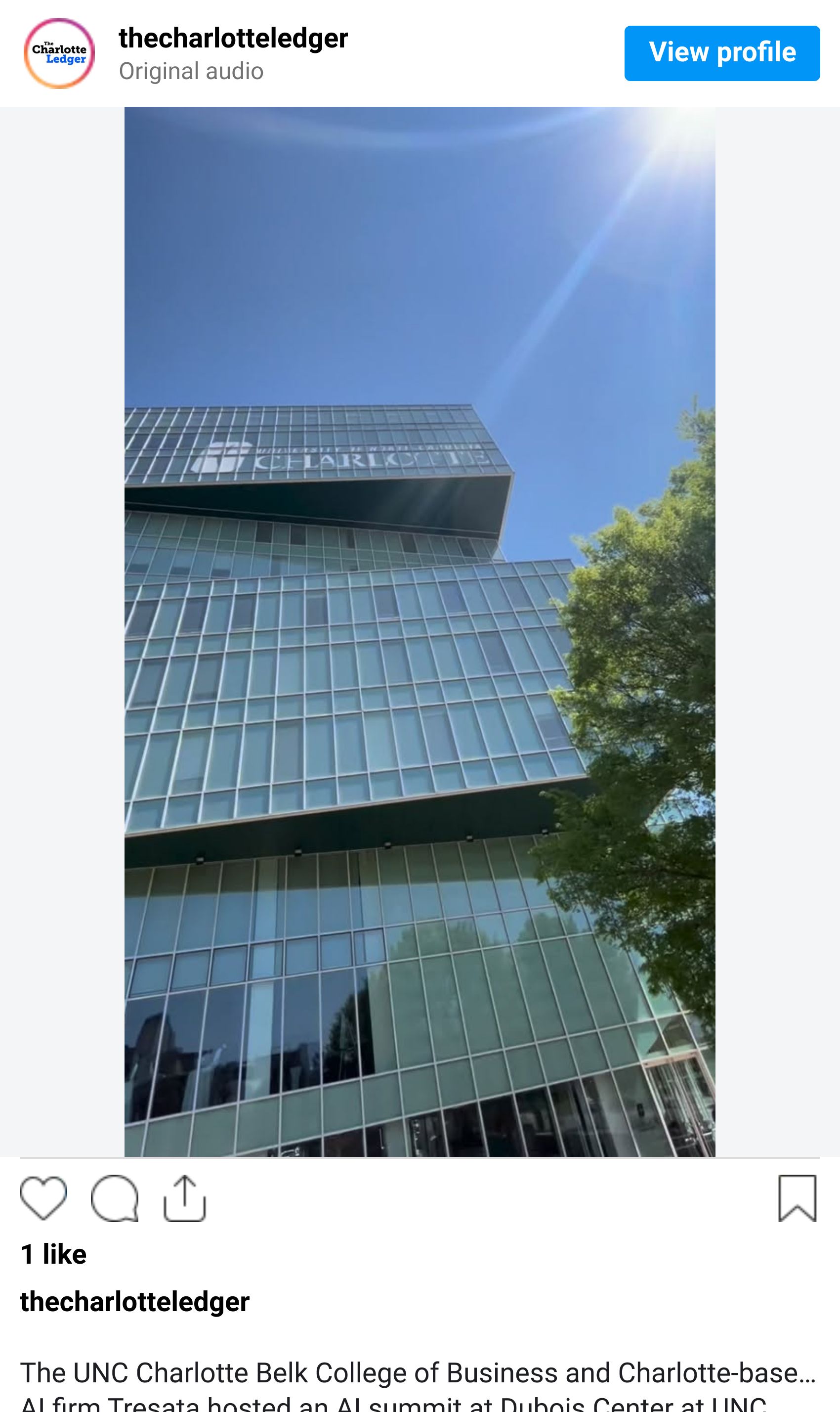
A panel that included Michael Hoes, a senior legal executive at Bank of America, at a recent AI summit at UNC Charlotte’s Dubois Center in uptown. (Photo by Ashley Fahey/The Charlotte Ledger)
He said AI has, in fact, driven home this “deep human need” to have things that are aesthetically pleasing and meaningful. And that translates to how companies, brands and others think about how they use AI, especially in marketing, social media and communications.
In fact, the Wall Street Journal reported in December that the percentage of LinkedIn job postings in the U.S. that included the term “storyteller” doubled in the past year.
“There’s going to be experimentation and brands who experiment,” said Barry Finkelstein of Charlotte-based Truth Advisors, a communications consultant. “Oftentimes, they're the ones who get punished when the market reacts negatively. But that's what’s needed to find where the tipping point is.”
Chris Moxley, the co-owner of Charlotte apparel company 704 Shop, said at the recent AI summit that although AI can be instructed to create or write something in a specific tone, “your customers know your voice.”
“I think we’ve all seen enough AI to know when AI is being leveraged for content,” Moxley said. “If you’ve built your brand on the people behind the brand being as critical as the products themselves, [and] you start to strip some of that away, you have to pay attention to what happens to the brand.”
The best approach for companies is to be transparent about their use of AI, said Laurie Carey, a longtime tech executive and CEO of Nebula Academy, a Charlotte-based professional development and workforce training company. If companies are using AI in a way that’s trying to masquerade as human-generated content, people are more likely to react negatively because they feel like they’re being tricked, she added.
She said she’s used AI to call executives for her own business. In her message, she says, “Yes, this is my AI voice.”
“You have to be blatantly obvious and not try to hide it,” she continued.
Finkelstein shared a similar sentiment, saying AI in communications is a big topic of conversation right now. Being forthright and transparent — both externally, in marketing, as well as internally, if job cuts are coming because of AI — is the best approach, he added.
Skepticism among workers
Just about every white-collar profession is adapting AI to some extent, and experts who advise companies on AI say the more a worker can prove they are competent at AI, the better off they will be.
That could feel somewhat contradictory to the widespread fear that AI will eventually replace humans in certain roles, perhaps especially software engineers, administrators, writers and editors, and researchers and analysts.
Carey said, unlike other big technology evolutions in the past several decades, AI has gotten its “tentacles into everything” practically overnight.
“What we teach for businesses and individuals is to look at it as a way to make you better,” she said. “You really have to look at it as a teammate, someone you can talk to and have conversations with and ask for help, in ways you couldn’t do before.”
One of the biggest mistakes she sees companies making is cutting jobs without a defined strategy around AI. When there’s a lack of education, things can go wrong, so workers and leaders need to learn how to use AI responsibly and ethically, she added.
Rick Doten, founder and principal of Charlotte-based Prescient Cyber Risk, an AI and cybersecurity advisory firm, said he’d estimate 95% of firms he speaks with are not leveraging AI in a way that massively displaces staff yet.
“It’s mostly [figuring out] the emotional step of accountability — who is accountable when AI is doing something? What if it makes a mistake?” he said.
Still, Doten said, some organizations are being pushed by leadership to simply “do something” about AI, but there isn’t a clear goal or stated reason behind using AI beyond a vague sense of wanting to keep up with technology and cut costs. That tends to be where mistakes happen, he added.
“Don’t follow the headlines, follow the business strategy,” he said.
Ashley Fahey is The Charlotte Ledger’s managing editor. Reach her at [email protected].
—
AI at your job?
We want to hear from you: How is AI showing up in your job right now? Are you using it? Or feeling its impact in ways big or small? Share your experience with us and help inform our coverage of how AI is changing work in Charlotte. (Drop us an email at [email protected])
🎥 Watch: Here’s what Grant Thornton’s CEO told The Ledger about how the company is using AI:
REAL ESTATE WHISPERS: Behind the 2,000 bank jobs
Big news Tuesday: Japanese bank SMBC announced plans for up to 2,000 jobs in Charlotte. A special edition of Real Estate Whispers and a Ledger podcast took a closer look at the deal. Whispers is our weekly look at commercial real estate development, with plenty of scoops and information you won’t find anywhere else.

Hirofumi (Hiro) Otsuka, the CEO of Sumitomo Mitsui Banking Corp.’s Americas division, speaks at a news conference on April 7. (Photo courtesy of the city of Charlotte)
🇯🇵 A year-long recruitment push — including trips to Japan and learning business customs
🏦 Why Charlotte beat out competitors and keeps winning banking jobs
🏢 Where this could land uptown — and what it might mean for vacant office buildings
You might be interested in these Charlotte events
Events submitted by readers to The Ledger’s events board:
APRIL 18: “Saturday Music and Art Camp,” 9 a.m. to 4 p.m., at Arts+ Community Campus, 2304 The Plaza. Come bring your kids for a fun camp while you take a break with a morning, afternoon, or day off! Children will play music together, explore instruments and make artwork to take home while adults enjoy community events or get some time back in their days! $50 for Half-Day. $100 for Full-Day.
APRIL 19: “IDK House Portraits with Sharon Dowell,” 1-4 p.m., at Arts+ Community Campus, 2304 The Plaza. Join local artist, Sharon Dowell, and create abstract paintings that portray a sense of home. Participants will leave with a new perspective on how to experience places, techniques for creating vibrant works and a finished house portrait. $75.
APRIL 25: “Thrown Together Potters Spring Sale,” 10 a.m. to 4 p.m., at 1225 Dade Ave. Join Thrown Together Potters for its 2026 Spring Sale. Explore and shop an exceptional selection of handcrafted pottery and original artwork created by some of North Carolina’s most talented artists. Meet the artists, hear the stories behind the pieces and gain insight into the techniques and inspiration that shape each collection. Registration requested. Free.
APRIL 25: “Queens Wedding Showcase,” 11 a.m. to 3 p.m., at Queens University of Charlotte, 1900 Selwyn Ave. This one-day event offers the opportunity to explore the university’s stunning venues, connect with industry professionals and gather inspiration for every detail of the wedding journey. The event will start at the newly renovated Belk Chapel. RSVP is required for entry. Free.