Good morning! Today is Saturday, March 21, 2026. You’re reading The Charlotte Ledger, an e-newsletter with local business-y news and insights for Charlotte, N.C.
Today's Charlotte Ledger is sponsored by The Village on Morehead’s Aging Boldly Series, which continues March 25, 10-11:30 a.m., featuring author Fabi Preslar leading a discussion on writing, storytelling and publishing with community authors.

Elizabeth Lawrence: She turned her Charlotte backyard into a living laboratory, pioneering the research and rigor that redefined gardening across the Southeast
Editor’s note: You see their names on street signs or parks, but who were some of the big-name people from decades ago who shaped Charlotte? They have fascinating stories, and for the next few Saturdays, we’re sharing them with you.

by John Short
For decades, Elizabeth Lawrence’s home and garden in Charlotte served as a living laboratory where she documented the seasonal success of hundreds of plant varieties.
Her philosophy was characterized by a rare blend of hands-on experimentation, intellectual curiosity and fundamental appreciation for nature. While she valued the physical labor of the soil, she believed intellectual rigor of the grower was equally important, famously writing: “One must be as willing to study as to dig, for a knowledge of plants is acquired as much from books as from experience.”
Lawrence, a pioneering landscape architect and writer, transformed the study of gardening in the Southeast. Through extensive literary contributions — including landmark books, a long-running newspaper column and a published collection of letters exchanged with legendary New Yorker editor Katharine White — Lawrence championed the historical preservation of landmark gardens and the rigorous research required to understand the unique climate of the “Middle South” region.
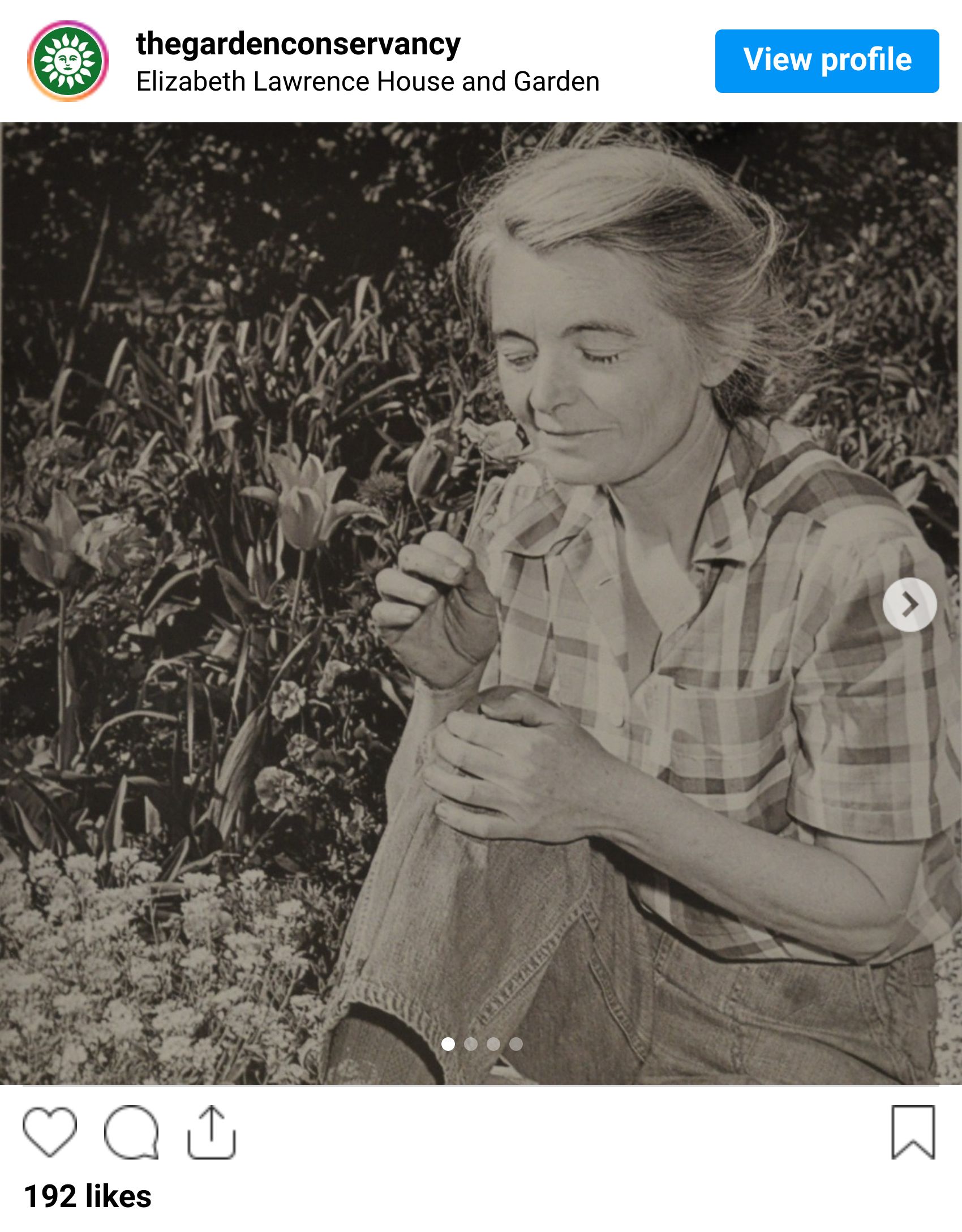
The growth of Elizabeth’s passion for horticulture began with her mother’s dedication to their home garden. Born on May 27, 1904, in Marietta, Ga., to Samuel and Elizabeth Lawrence, her family relocated to Raleigh in 1916. Lawrence had a robust education, attending St. Mary’s School in Raleigh before earning a degree from Barnard College in New York City in 1926. Upon returning to the South, she enrolled at North Carolina State College (now N.C. State) and made history in 1932 by becoming the first woman to graduate with a degree in landscape architecture.
After a brief stint in landscape design, she was drawn to writing, and in 1942 published her landmark book, “A Southern Garden: A Handbook for the Middle South.” Met with national acclaim, the book was the first comprehensive guide to discuss the unique needs of growers in USDA zones 7 and 8. It established Lawrence as a leading national voice on the subject and reinforced that the South had its own distinct, year-round gardening potential. This recognition was formally given to her in 1943 as the first female winner of the Herbert Medal, the top honor of what is now the International Bulb Society.
One must be as willing to study as to dig, for a knowledge of plants is acquired as much from books as from experience.
In 1948, following the death of her father, Lawrence and her mother moved to Charlotte to be closer to her sister. She purchased a modest lot at 348 Ridgewood Ave. in Myers Park and set about designing an outdoor laboratory garden she could craft in the style she had written about for years.
She argued that true knowledge of plants required growing them firsthand, and she designed her Charlotte property as a rigorous testing ground. Because most existing horticultural literature written to date was a reference for northern or English climates, Lawrence meticulously experimented with heirloom plants, species native to the Carolinas and exotic bulbs from around the world to determine exactly what could survive the heat, humidity and clay soils of the upper South.
As her experimentation deepened, her garden grew to feature a vast diversity of flora, operating with a constant “conveyor belt” of plant material. She pioneered the concept of installing plants in “communities,” intentionally grouping flora that shared common light, water and soil requirements, which was a revolutionary idea at the time.
The data she gathered from her hands-on research directly fueled her garden writing. Closely observing her garden from her study window, she maintained thousands of 3-by-5 index cards filled with handwritten notes detailing her plants’ behaviors, blooming dates, successes and failures over the years. This database of index cards would grow to a collection of roughly 13,000, each meticulously highlighting the details of a plant.
Her Ridgewood Avenue garden impacted the community, and from 1957 to 1971, she wrote over 700 weekly columns for The Charlotte Observer. Lawrence used the columns to openly share her horticultural ups and downs, teaching locals about the history and science of plants that would thrive in the region. Her column was widely read by home garden enthusiasts, creating a massive local network. Readers frequently wrote in, sending her seeds and sharing the successes and failures of their own gardens.
In addition to her column, Lawrence’s Charlotte property served as the inspiration and setting for two of her most famous books: “The Little Bulbs” (1957) and “Gardens in Winter” (1961). The latter was particularly influential in altering the perception that Southern gardens were merely spring and summer spaces that went dormant in the winter. By championing winter blooming in “Gardens in Winter,” Lawrence actively changed what Charlotteans were planting and encouraged her readers to embrace the fact that the city’s climate allowed for year-round beauty.
During this period, Ridgewood Avenue was arguably the most important street in Southern horticulture. Lawrence ran her “living laboratory” on one end of the street, while her friends Elizabeth and Eddie Clarkson maintained their massive wildlife sanctuary, Wing Haven, down the street. These two active outdoor preserves combined during this era to make Charlotte seem like the capital of the Southern gardening world.

Lawrence’s Ridgewood Avenue property was eventually sold to the Wing Haven Foundation in 2008. Pictured above is the Wing Haven garden in 2011. (Photo from Flickr/JR P, CC BY-NC 2.0)
As her health declined, Lawrence moved to Annapolis, Md., in 1983 to be near her niece, passing away on June 11, 1985. However, her impact on Charlotte was permanently preserved.
Following her death in 1985, the property was purchased the next year by Mary Lindeman “Lindie” Wilson, who took on the immense task of rehabilitating the garden. Wilson later convened a group to explore preservation strategies, ultimately selling the property to the Wing Haven Foundation in 2008 and donating an endowment for a conservation easement held by the National Garden Conservancy.
Today, the Elizabeth Lawrence House & Garden is listed on the National Register of Historic Places and is open to the public as an educational horticultural center, much of the garden preserved in the way its designer intended. Lawrence is rightfully remembered alongside Thomas Jefferson as one of the preeminent figures in the horticultural history of the Southeast.
John Short is a freelance writer and co-host of The Charlotte Podcast who loves digging up Charlotte’s past and pondering its future. Say hey when you see him on the streetcar.
Today’s supporting sponsor is Arts+:

Catch up on The Ledger’s Reporters’ Roundtable discussion
Yesterday morning, Ledger editors Tony Mecia, Ashley Fahey and Lindsey Banks and health care reporter Michelle Crouch gathered around the virtual reporter’s roundtable to discuss the news and reporting that defined our week.
We explored the implications of sports gambling, the legislature’s early discussions on hospital taxes, a notable uptown land deal and a new golfer-tracking app debuting at Quail Hollow in the spring. We also talk about the Ledger’s NCAA March Madness bracket competition, a recent Charlotte Ledger Podcast episode on what it’s like to be a meteorologist in today’s climate and a few pop culture detours, including the Oscars and “The Bachelorette” drama.
You can watch below on YouTube, or on The Ledger’s Facebook and LinkedIn pages, where the roundtable was live-streamed.
This week in Charlotte: Legislators question hospital tax exemptions and ‘facility fees’; Hawthorne Lane bridge lawsuit drags on; Club West packed; Service strain on fire department; Charlotte FC's teenage sensation
On Saturdays, The Ledger sifts through the local news of the week and links to the top articles — even if they appeared somewhere else. We’ll help you get caught up. That’s what Saturdays are for.
Education
School enrollment slumps: (The Assembly) Across North Carolina, declining birth rates, rising housing costs and growing competition from charter and private schools are driving down public school enrollment, forcing districts to close or merge schools to balance shrinking funding.
Heavy phone use in schools: (WUNC) A new study from the University of North Carolina at Chapel Hill found North Carolina students spend two to three hours on their phones during the school day, averaging about 20 minutes per hour.
Politics
Legislators question hospital ‘facility fees’: (Ledger) North Carolina lawmakers are examining proposals to scale back hospitals’ long-standing tax breaks—potentially redirecting millions to governments—while hospitals warn the changes could strain care, especially in rural areas. They’re also taking a look at “facility fees” charged at clinics and doctors’ offices.
Debate over pantsless mayor video: (Observer) A judge is considering whether Mooresville must release town hall surveillance footage that is said to show Mayor Chris Carney pantsless after triggering alarms one night in October 2024, with WBTV arguing it’s a public record of clear public interest while the town counters the video should remain private because it is “criminal intelligence records” and the release could reveal “sensitive security information.”
Local news
Bridge lawsuit drags on: (Ledger) A construction company’s lawsuit against Charlotte over the long-delayed Hawthorne Lane bridge project remains unresolved after failed mediation, with the contractor seeking at least $115M. The case, now entering its fourth year, could head to trial later this year.
Potential service strain on fire department: (Observer, subscriber-only) Rising costs and long delays for new fire trucks are pushing the Charlotte Fire Department’s fleet to its limits, union leaders say. Without additional funding, officials warn the city could face service disruptions.
Business
New long international flight from CLT: (Ledger) Etihad Airways launched its first Charlotte-Abu Dhabi flight with a subdued debut amid Middle East tensions, marking CLT’s first Airbus A350-1000 service and a major step in expanding the airport’s global connections. It’s a 14-hour flight, the airport’s longest.
Family Dollar layoffs: (WBTV) The discount retailer plans to permanently close its distribution center on Monroe Road in Matthews, with 373 workers set to lose their jobs between May and August. State records show it is the second-largest layoff in North Carolina this year.
Sports
Sports betting linked to rising addiction: (Ledger🔒) Since North Carolina legalized mobile sports betting, calls to the state’s gambling hotline have more than tripled, with counselors reporting growing addiction issues among young men.
UNC Charlotte fires basketball coach: (WBTV) UNC Charlotte fired men’s basketball coach Aaron Fearne on Tuesday after three seasons and a 47-51 record, despite a recent run to the conference semifinals.
From the Ledger family of newsletters
Queens’ fearless coach takes his shot. Plus: Join The Ledger's bracket challenge; Bridge lawsuit drags on; Podcast with wealth adviser; Club West packed; Strong storms forecasted today; Sheepish behavior in east Charlotte
Wednesday (🔒)
As sports betting booms, so do gambling problems. Plus: Uneven spending threatens economic outlook; New police chief uniform; Remembering Penny Butler; UNC Charlotte fires basketball coach; Bank of America settles Epstein claims; Join Ledger March Madness challenge
Friday (🔒)
Lawmakers target hospitals’ prized tax perks. Plus: PSA Airlines opens HQ; Truist Championship to debut golfer-tracking app; Why an uptown office building sold for $3.5M; Family Dollar layoffs; Middle East flight to CLT begins today; Potential service strain on fire department
Ways of Life (🔒)
In memoriam: Penny Butler, a full life, to 106 years. Also remembered: The co-founder of Metrolina Regional Scholars Academy; a longtime Charlotte firefighter; a nationally recognized children’s advocate
What about Charlotte FC's teenage sensation? Plus: Ream readies for final USMNT camp, Bronico reaches 150 games, MLS releases ’27 season format and Saturday preview
Why an uptown office building sold for less than $4M. Plus: Company looking at uptown offices; Savona Mill’s next phase; More apartments coming soon to Huntersville; Real Estate Whispers’ party (Ledger members only!); Ideas for the EpiCentre