
Will the city of Charlotte let go of Gateway Station?
New tax money could allow the transit authority to finish uptown's train station


You’re reading Transit Time, a weekly newsletter for Charlotte people who leave the house. Cars, buses, light rail, bikes, scooters … if you use it to get around the city, we write about it. Transit Time is produced in partnership between The Charlotte Ledger and WFAE.
Long envisioned as a major train and bus hub, uptown’s Gateway Station sits in limbo amid uncertainty over who gets to decide its future
by Steve Harrison
WFAE
In the fall of 2022, the N.C. Department of Transportation finished the $80 million track and signal work needed to open the Gateway Station and bring intercity passenger rail uptown.
All that was left was for the city of Charlotte to build a waiting area and ticket office for passengers, plus a few finishing touches on the station platform. The DOT could then move Charlotte’s Amtrak station from its current home — an outdated building on North Tryon Street near NoDa — to a prime location in center city.
But that hasn’t happened.
In the last decade or so, the city has juggled three options for Gateway:
build a permanent station as part of a massive mixed-use project of offices and residences
build a permanent station on its own
build a temporary station to get the project up and running quickly
Charlotte has done none of them. This is what Gateway looks like today:

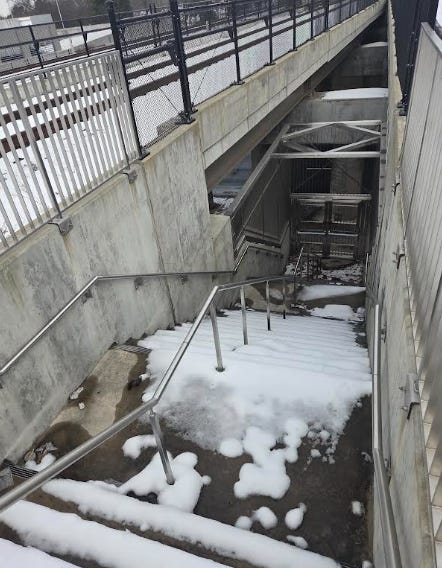
Now the project could have new life — if Charlotte is willing to let it go.
The new transportation sales tax starts July 1. There will be a huge influx of cash for rail transit. That money could quickly pay for a temporary, or even permanent, Gateway Station.
But it’s unclear if the city is willing to let the new Metropolitan Public Transportation Authority take the lead.
The new chair of the MPTA’s board, David Howard, said in an interview he would prefer to follow through on the city’s original vision of a mixed-use project in uptown — rather than getting Amtrak moved as fast as possible.
“I will advocate for a big mixed-use development,” Howard said. “A standalone building (station) is the fastest, but I don’t know if that’s what we want in uptown Charlotte.”
A bold plan, with little to show
The city’s vision for Gateway was formed about 25 years ago. Near the minor-league ballpark, it would be a transit hub that would spur a new downtown, at Trade and Graham streets.
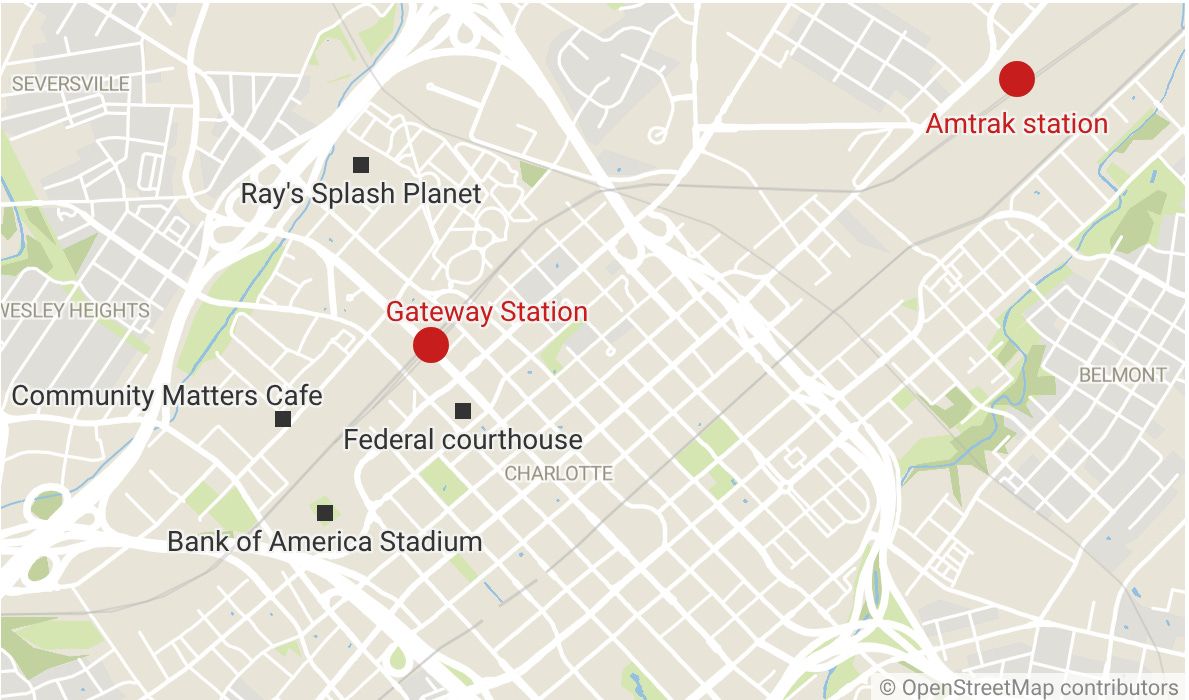
Gateway would connect the Gold Line streetcar (already built); the new Amtrak station (almost built); the Red Line commuter train to Lake Normal (planned, could be open in 10 years); the Silver Line light rail (planned, but at least a decade away); plus a small bus station and Greyhound station.
The development would also include offices, stores and apartments.
But there are problems with the vision.
Since Covid, the office market has struggled as thousands of employees continue to work from home. And that area of uptown may become a booming residential area, but there is little momentum there today. Most of the energy for new housing (not to mention offices) is about one mile away, in South End, or north of uptown along the Blue Line.
And waiting to build a train station until the private development is ready to build around it prioritizes that development over more effective intercity rail service, essentially telling Amtrak riders that they’ll be stuck using the inadequate North Tryon building until someone’s ready to build apartments and office buildings around Gateway.
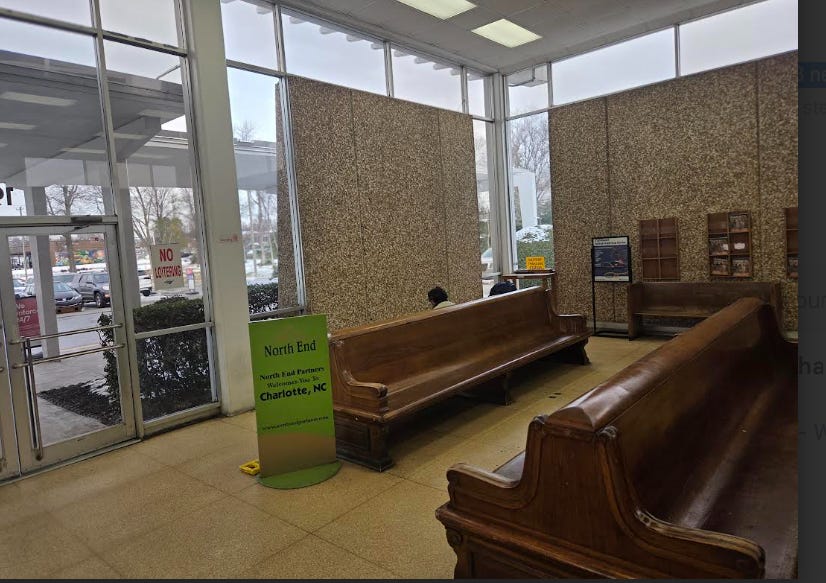
Instead of an attractive, useful, central rail station like Raleigh’s Union Station, Gateway has become one of many public-private partnerships that languished, including Mecklenburg County’s Brooklyn Village debacle and Inlivian’s (formerly the Charlotte’s Housing Authority) stalled redevelopment of Strawn Cottages in Dilworth.
The two private developers who were meant to build the offices, shops and apartments at Gateway — Spectrum Properties and Republic Metropolitan — couldn’t be reached for comment.
Axios Charlotte has done some of the best reporting on the Gateway delays, highlighting tensions between the city and the state over Charlotte’s reluctance to build a $16 million temporary station to open in 2027.
“I am writing to express our increasing concerns about the City’s ability to timely deliver the Charlotte Gateway Station, as evidenced through deviations from the overall ... schedule,” NCDOT’s Deputy Secretary for Multi-Modal Transportation Julie White wrote on July 31, according to the Axios article.
On Aug. 13, Charlotte Deputy City Manager Liz Babson told the DOT that the city couldn’t pay for both a temporary station and a permanent one.
An influx of money
Those money problems can be easily solved, starting this summer.
Sixty percent of the new sales tax revenue — about $210 million a year — will be directed to the MPTA. Two-thirds of that transit money, or $140 million annually to start, can be spent on rail transit.
The PAVE Act requires that the city transfer assets of the Charlotte Area Transit System to the MPTA.
The law also requires the authority to build the Red Line commuter train to Lake Norman first. The Gateway Station is part of the Red Line, and attorney Larry Shaheen — who helped write the bill — said the new transit money could be used for Gateway immediately.
The MPTA would have enough money in two months to build the temporary station. It could pay for it in cash.
The PAVE Act mandates the MPTA be responsible for running all transit, including buses, the light-rail, streetcar and the Red Line (which will use Gateway Station). The authority is also responsible for all future transit planning.
But the city of Charlotte appears to still want to shape Gateway’s future.
WFAE and Transit Time asked Charlotte Deputy City Manager Alyson Craig who will be making the ultimate decision for Gateway — the city or the MPTA?
Craig’s answer was vague, suggesting the city still wants to decide.
“The creation of the MPTA strengthens the existing public-private partnership supporting the CGS project by adding another partner,” she wrote. “It’s important that the MPTA is at the table as this project moves forward and we look forward to their participation.”
“At the table” does not sound like “decision maker.”
Transit Time also asked whether the temporary station is now more likely because of the new sales tax.
“Regarding the Amtrak station, the budget remains the same,” Craig wrote. “We will continue to work with NCDOT to identify the fastest path to deliver a station into uptown.”
Howard, the new MPTA chair, has worked on Gateway as a Charlotte City Council member and a staff member for the NC DOT and US DOT. He said one reason Gateway has been delayed was indecision over whether the Silver Line light rail would serve the station.
“That was one of the reasons it slowed down: We tried to figure out the Silver Line alignment,” he said.
But the Silver Line alignment was decided three years ago, shortly after the N.C. DOT finished its portion of Gateway.
Different land owners
Some of the land around Gateway is owned by the DOT. Some land is owned by the city of Charlotte.
It’s unclear if the city will transfer that land to the MPTA.
However, if the MPTA’s 27-member board wants to move fast on Gateway, it appears the authority could start negotiating with the DOT — and leave the city of Charlotte out.
The authority is hosting an all-day retreat today (Thursday) to discuss its long-term plans.
Steve Harrison is a reporter with WFAE, Charlotte’s NPR news source. Reach him at sharrison@wfae.org.
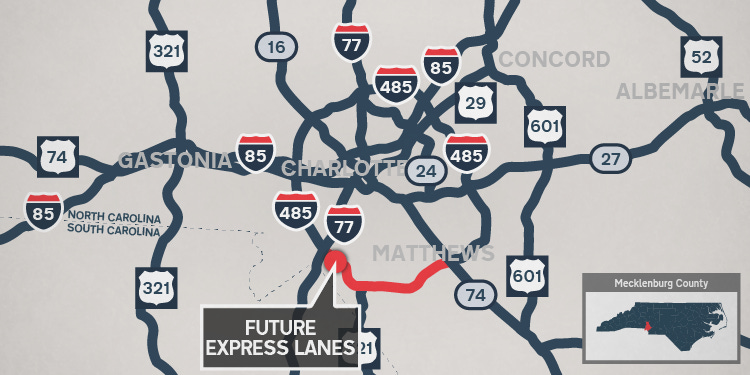
Despite opposition, DOT says it will build elevated express lanes on I-77 in uptown
by Steve Harrison
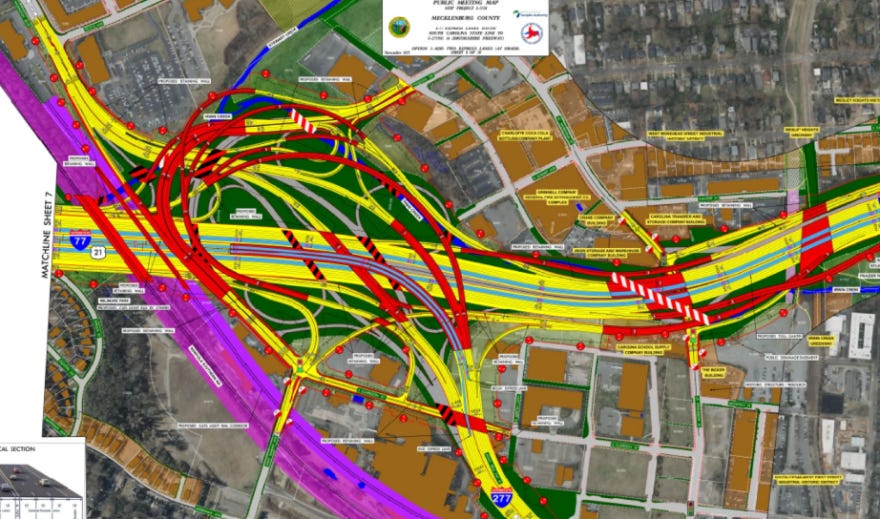
The N.C. Department of Transportation said Wednesday it has decided to build part of the Interstate 77 express lanes project through uptown by elevating the toll lanes.
The DOT considered two options for the massive, $3.2 billion rebuild of I-77.
One option was to build the new lanes at grade, or at the same level as the existing lanes. That would have created the widest footprint.
The other option was to elevate the toll lanes through uptown by putting them on top of the existing interstate highway.
The state said the elevated option “significantly reduces property impacts to McCrorey Heights and Wesley Heights” and minimizes the amount of land taken from Frazier Park. It also doesn’t impact Pinewood Cemetery.
Some neighborhood leaders had urged the state to either not widen the highway or to look at placing part of I-77 below ground. Cities such as Boston and Seattle have buried highways.
They have said elevated toll lanes will be ugly and increase noise.
The DOT, however, said that placing the highway underground would be too expensive.
The group Sustain Charlotte criticized the plan, saying most of the DOT’s community engagement was done before the elevated plan was unveiled.
“Most of the community engagement they cite occurred before either of these designs were made public,” said Shannon Binns, Sustain Charlotte’s executive director. “You can’t meaningfully weigh in on impacts, tradeoffs or alternatives if you’re not told what’s actually being proposed.”
The state plans to partner with a private developer to build and manage the toll lanes. The widening project will be one of the most complex and expensive road projects in the state’s history.
The toll lanes will run from uptown to the South Carolina line. When finished, the new lanes will connect with existing express lanes on I-77 north and new toll lanes on I-485 that are opening later this month.
NCDOT sets date for opening of I-485 toll lanes: Feb. 28
The N.C. Department of Transportation has settled on an opening date for toll lanes on 18 miles of I-485 in southern Mecklenburg: Feb. 28 at 6 a.m.
The tolls for the new lanes will vary based on the time of day and day of the week. Drivers can save 50% on the tolls with an N.C. Quick Pass sticker.
After the lanes open, there will still be ongoing work to install lighting and signs as well as occasional lane closures on East John Street and Weddington Road, NCDOT said. —Tony Mecia

Transit Time is a production of The Charlotte Ledger and WFAE. You can adjust your newsletter preferences on the ‘My Account’ page.
Did somebody forward you this newsletter and you need to sign up? You can do that here:
Other affiliated Charlotte newsletters and podcasts that might interest you:
The Charlotte Ledger, Ways of Life newsletter (obituaries), Real Estate Whispers (growth and development), Fútbol Friday (Charlotte FC) and Toppman on the Arts (arts reviews) available from The Charlotte Ledger.
The Inside Politics newsletter, available from WFAE.