
Three Gantt Center exhibits that stir the soul and settle the mind
The exhibitions run into 2026 at the Gantt Center, 551 S. Tryon St.

This review by longtime Charlotte arts critic Lawrence Toppman was published by The Charlotte Ledger on December 19, 2025. You can find out more about The Charlotte Ledger’s commitment to smart local news and information and sign up for our newsletter for free here. Ledger subscribers can add the Toppman on the Arts newsletter on their “My Account” page.
Review: A visit to the Gantt Center moves from raw, furious expression to joyful movement and finally to a reflective calm, leaving the viewer emotionally full and quietly smiling
by Lawrence Toppman
I went from rage to pleasure to mysterious calm in two hours and 200 feet last week at the Harvey B. Gantt Center for African-American Arts + Culture. By the end of my visit to three exhibits, my brain was full, but my face was smiling.
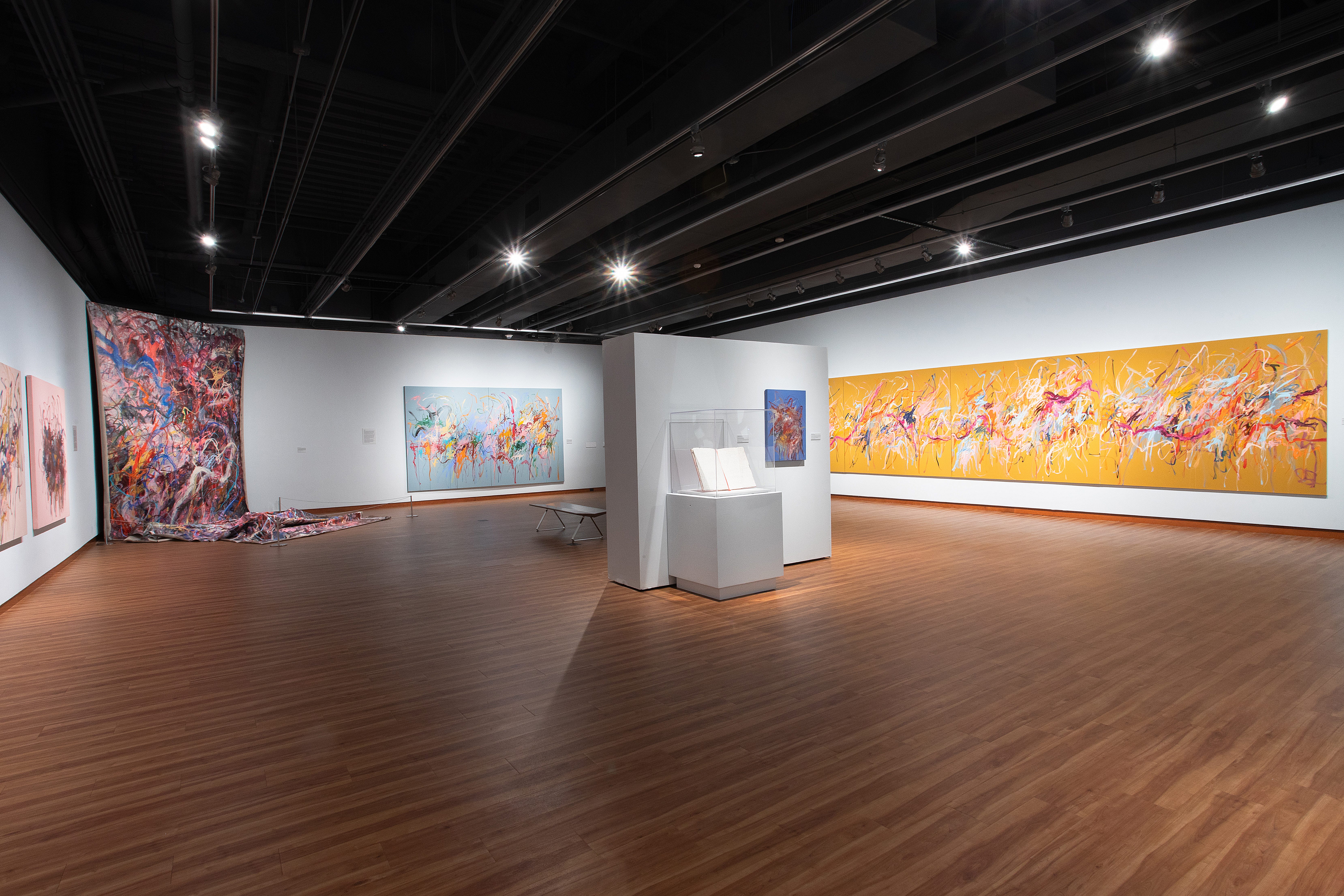
If you get museum fatigue quickly, start with “A Time for Furious Dancing” on the third floor. Painter a’driane nieves, who doesn’t use capital letters in her name, took the title of her first solo museum exhibit from Alice Walker’s book of poems “Hard Times Require Furious Dancing.” Nieves uses the adjective in both senses: Her thickly applied paintings have a fierce energy, and they come from someone who’s often expressing fury at the world.
They began in 2011 as art therapy and probably still serve that purpose. The titles, so long that one would take up an entire paragraph, end like this: “Survival has become a prison and a gravity well swallowing me and all of our dreams whole.” A piece she calls “Red Sketchbook” contains only the sentence “I am dancing this grief and fury around and around,” repeated over two pages. One immense canvas starts at the ceiling, goes to the floor and protrudes into the room, like a tongue spilling out of an anguished mouth.
Yet the show isn’t a downer. Three paintings bear the subtitles “A dance of open minds:” She has unpacked hers and wants to open yours. As you walk through the gallery, knots of many colors from which tendrils emerge wildly take on a different feeling. You find movement in abstract shapes that lean, leap, roll. The largest work, titled (in part) “Learning how to hold onto more than crisis,” dances the length of one wall across four panels, moving from pain toward the joy of revealing yourself to the world.
There’s dancing at the other end of the third floor, too, in the exhibit “Jazz Greats: Classic Photographs from the Bank of America Collection.” These photos capture impeccably dressed swing dancers in states of ecstasy at clubs or house parties and depict singers and instrumentalists in action and repose. (Or both at once, in the case of trumpeter Miles Davis.)
Irrepressible Dizzy Gillespie shows up in three photos: He executes a step on Manhattan’s famously jazzy 52nd Street, adores the scatting Ella Fitzgerald and puffs his cheeks to display his unique embouchure to French children. Yet the star of the exhibit is photographer Chuck Stewart, whose work adorned a reported 2,000 albums and magazine articles. He took the most touching shot here, one of saxophonist Eric Dolphy gazing in 1964 toward a future he would never know; Dolphy died on tour in a diabetic coma a few months later.
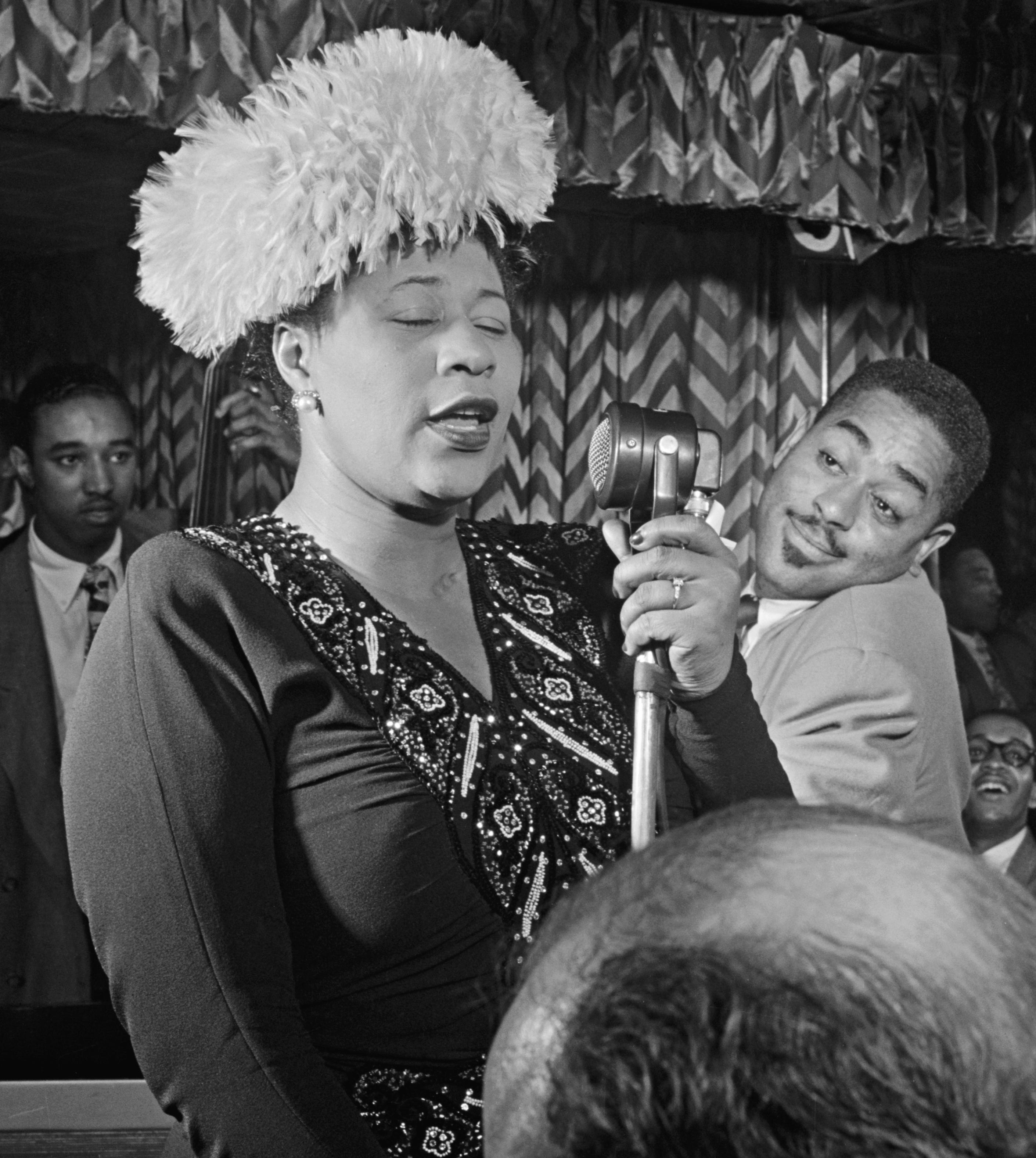
For all the excitement of seeing a perspiring Billie Holiday woo an audience, I most enjoyed photos of artists at peace: John Coltrane meditatively cradling his sax, pianist-composer Mary Lou Williams lost in thought. The exhibit has three Carolinas connections: Coltrane comes from Hamlet, N.C., Gillespie from Cheraw, S.C., and Williams taught at Duke University. (We could’ve had all of the Big Five, had Tryon’s Nina Simone and Rocky Mount’s Thelonious Monk been there.)
As you amble, listen carefully to the soundtrack, which goes back to big band music and forward to bop. I was leaving when I heard the opening of Coltrane’s “My Favorite Things” and had to stay another 10 minutes; I never get off a ‘Trane until it comes to a complete stop.
“Praise House,” one floor down, takes its name from a small black-and-white photo of a humble wooden chapel on St. Helena Island. Adama Delphine Fawundu uses it to link her Mende roots in Sierra Leone to this South Carolina center of Gullah culture.
For Fawundu, the African Diaspora reaches from the American South to South America and beyond. Actions in her photos can be as mundane as men cutting potato leaves or as mystical as a woman stretching out her arms against an ancient wall in Buenos Aires, while she wears a dress of dazzling blue and a mask of shells and African cloth. Her gesture echoes the lines of an adjacent photo from Colombia, a wall silhouette of a soldier holding up his rifle.
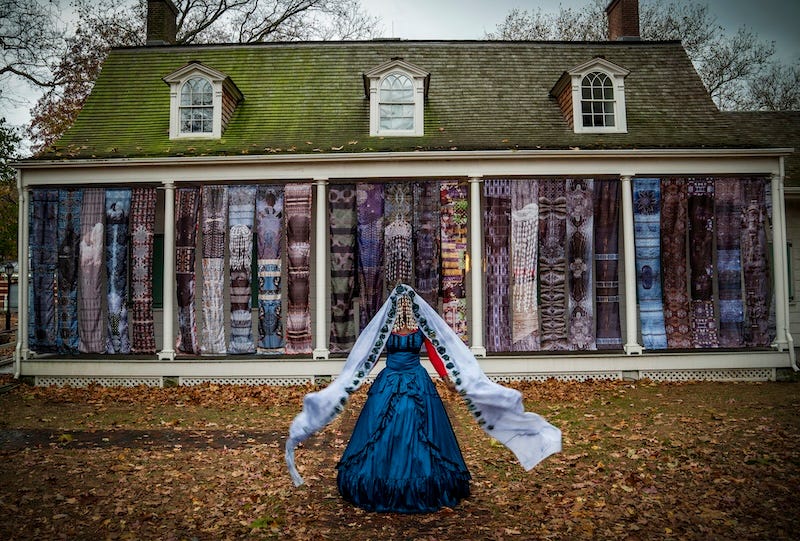
Hands and feet figure prominently, perhaps as extremities that connect us to other people and the Earth; a wall plaque by Fawundu talks about àṣẹ, the vital force the Yoruba consider the source of all existence and a link to everything on the planet. Water has healing, even sacred, powers for Fawundu. Unidentified masked or shadowy characters recur in poses and settings I couldn’t always interpret.
Soon I started to read extra meanings into even simple photos, such as the lined, amiable face of Paramount Chief Edna Fawundu (a relation?) in the Sierra Leonian district of Bo. Yet only once does the artist result to overt social commentary, in four photographs of a handsomely dressed Mende woman visiting a former plantation site in Virginia. The contrast between young beauty and old evil makes the point clearly.
If You’re Going
These exhibits run into 2026 at the Gantt Center, 551 S. Tryon St. “A Time for Furious Dancing” will be there through Jan. 4; “Praise House” will be up through March 8; “Jazz Greats” stays through April 26.
—
Lawrence Toppman covered the arts for 40 years at The Charlotte Observer before retiring in 2020. Now, he’s back in the critic’s chair for the Charlotte Ledger — look for his reviews several times each month in the Charlotte Ledger.
Need to sign up for this e-newsletter? We offer a free version, as well as paid memberships for full access to all 6 of our local newsletters:
The Charlotte Ledger is a locally owned media company that delivers smart and essential news. We strive for fairness and accuracy and will correct all known errors. The content reflects the independent editorial judgment of The Charlotte Ledger. Any advertising, paid marketing or sponsored content will be clearly labeled.
◼️ About The Ledger • Our Team • Website
◼️ Newsletters • Podcast • Newcomer Guide • A Better You email series
◼️ Subscribe • Sponsor • Events Board • Merch Store • Manage Your Account
◼️ Follow us on Facebook, Instagram, X/Twitter, LinkedIn, Substack Notes