
Medical no-shows spiked amid immigration arrests
Even legally documented patients are staying home, providers say
The following article appeared in the Nov. 21, 2025, edition of The Charlotte Ledger, an e-newsletter with smart and original local news for Charlotte. We offer free and paid subscription plans. More info here.
Fear kept undocumented immigrants and legal residents in Charlotte from seeking treatment for tuberculosis, diabetes and serious injuries; providers say it could take months or years to rebuild trust
By Michelle Crouch
When a Charlotte man fell off a ladder last week and likely fractured his foot, his doctor told him he needed to go to the hospital for an X-ray. But the man, the Latino owner of a small construction company, refused to go, the doctor said.
He was too afraid he might run into U.S. Customs and Border Protection agents, even though he’s in the country legally.
“This is a documented patient. He has insurance,” said the doctor, a family medicine physician at a federally qualified health clinic in Charlotte. “But he said, ‘I have a Latin last name. I’m too scared to wait in the lobby.’”
The man’s foot “100% is not going to heal right,” said the physician, who asked that she and her clinic not be identified out of concern that the center could become a target.
The Border Patrol, which arrived in Charlotte last Saturday, has arrested more than 370 people in the area as of Thursday.
During the crackdown, large numbers of patients too afraid to leave their homes have been skipping time-sensitive medical care, local health providers said. Missed appointments are skyrocketing, and patients aren’t showing up even when they need treatment for potentially dangerous conditions.
Fear isn’t keeping away just undocumented immigrants, but many U.S. citizens who worry about harassment or who distrust law enforcement, health care providers said.
Although many clinics offer virtual appointments, that only goes so far, the family medicine doctor said.
“I have patients who need wounds checked, ulcers looked at and procedures done, and I can’t do that from the computer,” she said. “The populations I tend to manage are the most vulnerable and most sick. I deal with a lot of life-threatening conditions like HIV and hepatitis. These are people who should not wait — who cannot wait — to access care.”
Even after the agents leave Charlotte, community leaders say the fear and disruption won’t disappear right away.
Hospitals, clinics no longer protected spaces
For years, hospitals and clinics were categorized as protected areas that immigration agents rarely entered, but that policy changed in January 2025. On Sunday, Border Patrol agents arrested an immigrant who was hiding in the ceiling tiles of Atrium Health University City hospital, according to WSOC-TV.
Gina Esquivel, an administrator for Charlotte’s Latino Leadership Council, said the new federal policy, along with this week’s enforcement actions, has fundamentally changed how many Latino families view the health care system.
“For 40 years, these hospitals have invested in community outreach and built trust, but now it feels like there’s no place that is safe,” she said. “If you have an emergency, you have to negotiate how bad your emergency is, do you really need to go. There’s just no safe space anymore.”
Health care providers worry it could take months or years to rebuild patient trust.
“Even when the operations themselves end, there will be lingering fear and concern,” said Mecklenburg County Health Director Raynard Washington. “It takes time to get people to re-engage in care. But the longer people aren’t accessing services, the more acute their health conditions will get.”
No-shows spiked in public health clinics
Washington said Mecklenburg County saw a 50% drop this week in the number of women coming in for nutrition and breastfeeding support through the Women, Infants and Children program.
His staff also reported sharp increases in missed and canceled appointments at its adult sexual health and tuberculosis clinics, he said.
Tuberculosis control is one of the county’s most urgent public-health responsibilities because the disease spreads through the air and requires uninterrupted treatment to keep cases from escalating, developing drug resistance or spreading to others.
“Because tuberculous control is such an important part of what we are responsible for, we are trying to create pathways for patients with active TB by delivering their medications,” Washington said on Wednesday. “It’s a service we have offered historically, but demand has increased in the last few days.”
Patients went without medications, caregiving support
At one Charlotte clinic that serves mostly immigrant families, staff members called every scheduled patient to offer virtual appointments, and many quickly switched, a case manager said. He asked not to be identified because he worried speaking publicly could draw unwanted attention to the clinic.
“It feels like early Covid,” he said. “The need is huge, and people are too afraid to come in for basic care.”
The clinic’s biggest challenge has been patients running out of critical medications and being unwilling to leave their homes, he said: “People with diabetes and hypertension are rationing medication or going without. Without those medications, they could have some pretty significant health impacts.”
To keep patients safe, the clinic started delivering essential medications to patients’ homes.
But medications aren’t the only concern, the case manager said. Earlier this week, clinic staff were scrambling to figure out who could care for a very sick woman after her husband — her primary caregiver — was deported.
‘My 17-year-old was shaking’
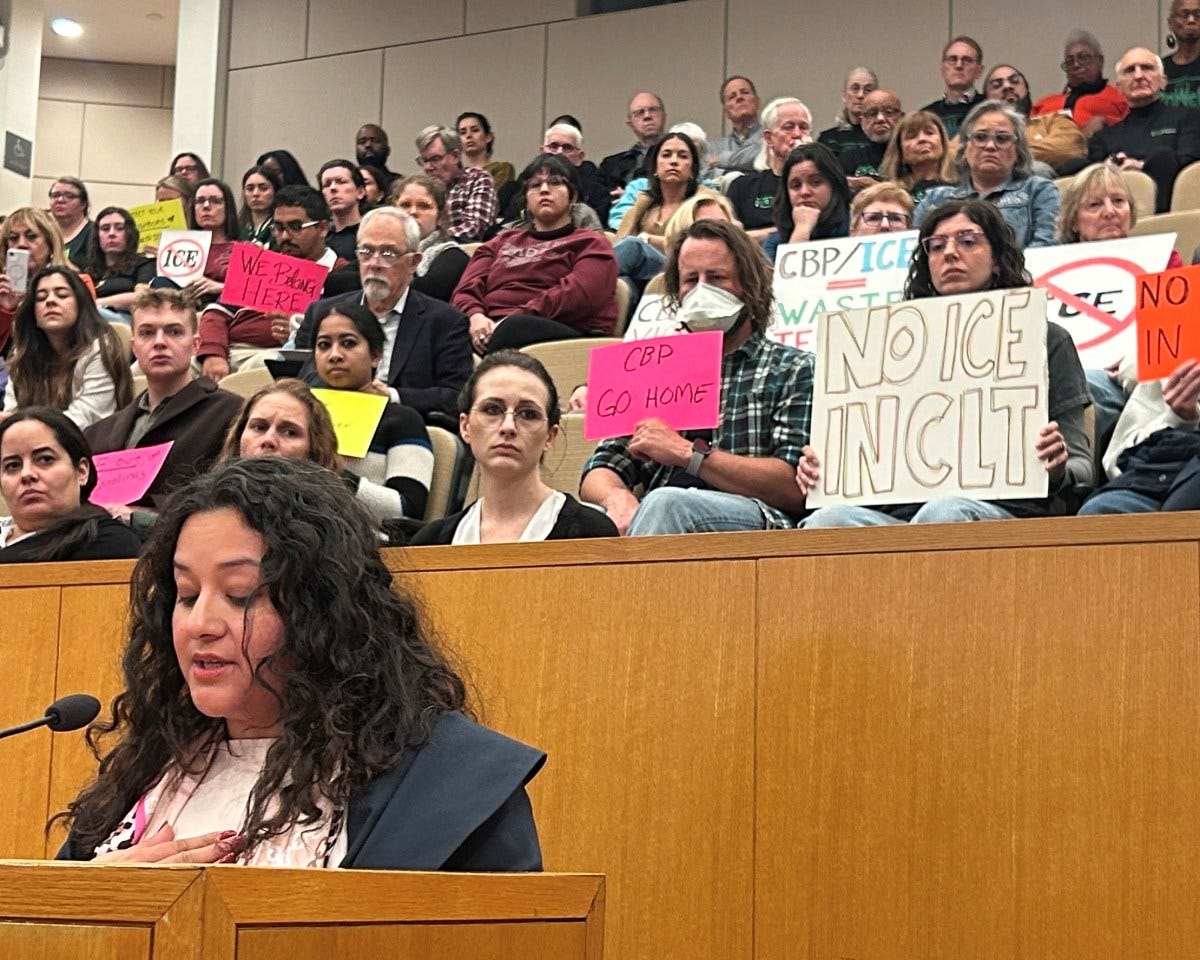
At the Mecklenburg County board of commissioners meeting on Tuesday, speakers protesting the Border Patrol operation described residents afraid to leave their homes to take out the trash, let alone stand in line at a pharmacy. They said cancer patients were skipping treatments, children were having panic attacks and adults already haunted by memories of la migra in their home countries were being re-traumatized.
“Last night at the dinner table, my 17-year-old was shaking because he was afraid if he got pulled over and he couldn’t prove he was a citizen, he would get arrested,” Omar Jorge Peña told the board. “He is an American citizen, and he is living with this fear. The trauma and the damage that is being caused by these actions is not going to be resolved when they leave.”
Mental health clinicians said they have seen a surge in distress, along with spikes in anxiety, high blood pressure and worsening depression.
“Children have expressed deep anger and fear,” said Miriam Espaillat, a licensed clinical social worker. “Parents are hyper-vigilant and experiencing symptoms that can create long-term damage to physical and mental health.”
Mental health toll will linger
Community clinics said their behavioral health teams have been slammed this week, and the limited number of Spanish-speaking therapists in Charlotte has left many providers feeling stretched.
Although churches, nonprofits and advocacy groups are offering workshops, support groups and free therapy sessions, the need has been overwhelming, said Indiana Torres, a licensed clinical social worker who works with many Latino families.
Torres said she has seen a 40% to 50% increase in anxiety-related visits since January, even among clients who are U.S. citizens or have legal status. The need intensified this week, she said.
What clients share most often is a sense of helplessness and hopelessness, she said: the feeling that they cannot protect their children, that they are being labeled as criminals despite working and paying taxes, and that their children are hearing the message that “they don’t want us here.”
“It’s a nightmare,” Torres said. “With most traumas, there is some kind of endpoint. This is constant. You’re worried that at any moment, you could be separated from your family.”
That type of constant fear and uncertainty can become chronic stress, which affects immunity, heart health and children’s brain development, she said.
“We are creating a generation of kids who will struggle with learning, relationships and chronic illness because they are living through this,” she said. “This is truly a humanitarian crisis with measurable health consequences that could last long after the crisis ends.”
Michelle Crouch covers health care. If you have tips or ideas for her, please shoot her an email at mcrouch@northcarolinahealthnews.org.
This article is part of a partnership between The Charlotte Ledger and North Carolina Health News to produce original health care reporting focused on the Charlotte area.
➡️ You can support this effort with a tax-free donation. This coverage is supported by readers like you who value smart, transparent and independent reporting.
Need to sign up for this e-newsletter? We offer a free version, as well as paid memberships for full access to all 6 of our local newsletters:
The Charlotte Ledger is a locally owned media company that delivers smart and essential news. We strive for fairness and accuracy and will correct all known errors. The content reflects the independent editorial judgment of The Charlotte Ledger. Any advertising, paid marketing or sponsored content will be clearly labeled.
◼️ About The Ledger • Our Team • Website
◼️ Newsletters • Podcast • Newcomer Guide • A Better You email series
◼️ Subscribe • Sponsor • Events Board • Merch Store • Manage Your Account
◼️ Follow us on Facebook, Instagram, X/Twitter, LinkedIn